Theatre Commands: Can India’s military restructuring counter the China-Pakistan nexus
No doubt, India’s military faces a strategic challenge that can no longer be addressed through the traditional understanding of separate land, air and maritime battles. The ever-expanding defence partnership between Beijing and Islamabad has made the possibility of a coordinated two-front contingency a central concern for Indian defence planners.
Against this backdrop, establishing Integrated Theatre Commands is both necessary and overdue. The idea is straightforward: bring the Army, Navy and Air Force assets assigned to a particular geographical theatre under a single operational commander, to plan and fight as one force.
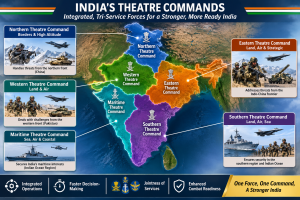
India’s proposed theatre command structure aims to integrate the Army, Navy and Air Force under unified operational commands to improve jointness, coordination and combat readiness. The structure remains a subject of organisational and strategic debate
Yet a critical question remains: Will theatre commands fundamentally improve India’s ability to deter and, if necessary, fight a war on two fronts, or will they merely rearrange the military’s organisational chart?
The answer depends on how India implements the reform. Delay is not the point here.
A two-front challenge demands a joint response
Along the northern and eastern borders, India must contend with the People’s Liberation Army’s infrastructure, surveillance networks, long-range precision weapons, air power and expanding space and cyber capabilities. On the western front, Pakistan maintains a substantial conventional military and a strategy that combines conventional deterrence with the threat of nuclear escalation and cross-border terrorism.
The concern is not simply that India might have to fight two adversaries simultaneously. It is that a crisis involving one country could create opportunities for the other to apply military pressure, stretch Indian resources and complicate strategic decision-making.
China and Pakistan do not need to operate as a single military formation to create this problem. Coordinated intelligence sharing, military supplies (equipment), technological cooperation and the timing of military actions might collectively try to impose costs on India.
For New Delhi, the challenge is to maintain credible deterrence along the Line of Actual Control with China while retaining sufficient forces, aircraft, missiles and naval capabilities to respond to a crisis with Pakistan. It must also protect the Indian Ocean approaches, where maritime power can influence the wider strategic balance.
A command structure designed primarily around individual services and their institutional priorities may struggle to deliver the speed and coordination required in such circumstances. Theatre commands offer a way to address that weakness.
Why theaterisation makes strategic sense
The proposed restructuring, as reported in 2026, foresees three principal commands: a Northern Theatre Command focused on China, a Western Theatre Command oriented towards Pakistan, and a Maritime Theatre Command.
The proposal’s final approval and implementation remain separate questions.
The principal advantage is unity of command. In a crisis, a commander responsible for a theatre should be able to assess the situation, prioritise forces and coordinate operations without waiting for multiple service headquarters to reconcile competing demands.
Consider a situation in which tensions escalate along the LoAC while Pakistan increases military pressure on the western border. India would need to coordinate intelligence, air defence, fighter aircraft, long-range fires, logistics, surveillance and cyber capabilities across multiple fronts. Theatre commands could improve the speed and coherence of these decisions.
More importantly, reform could make jointness a routine feature of military operations rather than something improvised when a crisis begins.
India has already gained experience in tri-service coordination through the Andaman and Nicobar Command since 2001. The challenge now is to extend meaningful integration across a much larger and more complex military establishment.
Theaterisation is definitely a logical continuation of that reform process.
China-Pakistan nexus requires more than geographical commands
However, the China-Pakistan challenge is extended to defence production, missile technology, air power, unmanned systems and maritime strategy.
China’s dogged assistance to Pakistan’s military modernisation has added much to India’s security calculations. Pakistan can draw on Chinese-origin military platforms, while China can exert pressure along the Himalayan frontier and also expand its influence in the Indian Ocean. Certainly, these developments complicate India’s ability to allocate scarce military resources across different theatres.
This is where the proposed structure needs careful thought.
A Northern Theatre Command cannot be designed exclusively around the Army’s requirements along the Himalayan frontier. It must integrate air power, intelligence, surveillance, precision strikes and logistics into the operational plan—and so must the Western Theatre Command.
The Maritime Theatre Command, meanwhile, should not be treated as a peripheral part of a predominantly continental security strategy. India’s naval strength and maritime surveillance to protect Sea Lines of Communication can influence the strategic calculations of both China and Pakistan.
Then the objective must be to prepare for a potential two-front contingency without assuming that every conflict will unfold simultaneously or in the same way. So, India’s command architecture should provide the flexibility to concentrate power where it is most needed.
The IAF question cannot be ignored
One of the most important issues in the theatreisation debate is the deployment of air power.
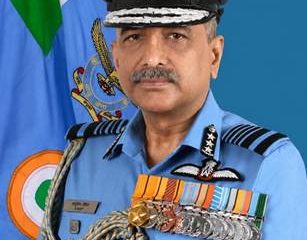
Air Chief Marshal A. P. Singh has supported theatreisation in principle while arguing for India’s own model.
However, the IAF’s reservations cannot simply be dismissed as resistance to institutional change. Fighter aircraft, airborne surveillance platforms, aerial refuelling aircraft and tactical transport assets can operate across large distances and support more than one front. The air power often lies precisely in its ability to move rapidly between theatres.
If too many aircraft and supporting capabilities are permanently allocated to separate geo-commands, then the problem would become particularly acute during a simultaneous crisis involving China and Pakistan.
The solution is to distinguish between forces assigned to a theatre and national assets that must remain available for wider strategic needs.
India needs a clear mechanism for deciding which assets are permanently allocated, which can be reassigned during a crisis, and who has the authority to make those decisions. National-level air defence, strategic surveillance and other capabilities with cross-theatre responsibilities must not become trapped in competing command structures.
A command structure is not a substitute for military capability
There is another uncomfortable reality: Theatres are no substitute for capability gaps, or a quick fix.
Theatre commands cannot manufacture additional fighter squadrons, speed up delayed equipment or accelerate production in a quick fix. Nor can they compensate for inadequate logistics, insufficient surveillance coverage or communications networks.
A two-front contingency would place extraordinary demands on India’s ability to sustain operations. The country would need adequate stocks of precision weapons, air-defence interceptors, artillery ammunition and other critical supplies. It would also need resilient maintenance and repair facilities, secure communications and industrial clusters to replenish equipment during a prolonged conflict.
This makes theatreisation inseparable from defence procurement and indigenisation.
India’s defence industry must be capable of delivering equipment at scale, while research institutions (DRDO) and private industry need to work more closely with the armed forces.
Here, unmanned systems, counter-drones, electronic warfare, AI, space surveillance and cyber defence must be integrated into operational planning rather than treated as separate modernisation projects.
Crucially, the same principle applies to financial planning. Theatre commanders need sufficient authority over the resources assigned to them, while the government and the service chiefs must retain responsibility for long-term force development and national priorities.
The danger of implementing reform in haste
India must also avoid treating the formation of theatre commands as a deadline-driven administrative exercise.
Very clearly, while taking a closer look at Chinese structure and American military style, theatre is fine, but there is no need to make haste. Indian structural changes demand time, especially in the matter of national security.
The proposed changes affect command relationships, operational doctrine, personnel management, logistics, training and the allocation of military assets. They will require considerable institutional adjustment across services that have developed different traditions, operating procedures and organisational cultures.
There must be clarity on the respective responsibilities of the Chief of Defence Staff, theatre commanders and service chiefs. The distinction between generating military capability and employing it in operations needs to be established beyond ambiguity.
The role of the government in strategic direction and nuclear decision-making must also remain unambiguous.
Additionally, cyber, space and other specialised capabilities that serve national objectives across multiple theatres require appropriate arrangements for central coordination and operational support.
India should therefore implement the reform in carefully sequenced stages, supported by joint exercises, simulated two-front contingencies and independent assessments of operational performance. Each stage should demonstrate measurable improvements in decision-making, coordination and readiness before the next stage is undertaken.
On top of that, critically, the government should also develop a clear national security and military strategy to guide the reform. An organisational structure cannot determine national priorities on its own; it must be built around them.
The real test: Can India fight as one force?
India has little reason to preserve institutional arrangements simply because they have existed for decades. The character of warfare is changing, and the possibility of coordinated potential conflict from China and Pakistan makes closer integration vital.
The reform must also preserve the flexibility to shift resources between theatres, particularly when air power, intelligence and precision-strike capabilities have national rather than exclusively regional value.
Theatre commands are a sound strategic direction for India, but they are not a stand-alone solution to the China-Pakistan nexus. The central question is whether integration must translate into a decisive operational and greater capability advantage.
In a potential two-front conflict, the difference between three services working alongside one another and three services fighting as one could be consequential. India must ensure that theatreisation delivers the latter.
Author


Leave a reply


SIDST- Strategic Insight for Defence Space and Technology- tHINK DEFENCE