
AI-powered drones: India needs a new defence-industrial model
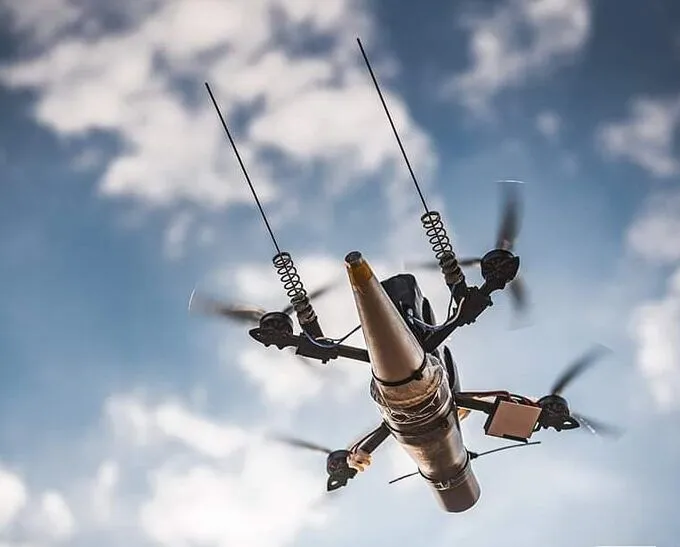
The next major transformation in warfare may not be driven by another generation of fighter jets, tanks or warships, but by millions of intelligent, networked and increasingly autonomous drones operating at a scale that traditional military systems may struggle to match.
India must therefore treat the rise of AI-powered drones as a national-security challenge and not simply as another technology programme, Lt General Raj Shukla (retd) said at the NDTV Defence Summit.
Using the Russia-Ukraine war as a real-world laboratory, Shukla argued that warfare is moving rapidly from remotely operated drones towards what he described as algorithmic warfare.
“Till last year, the locus of drone operations was with some very skilled remote operators,” Shukla said. Because the number of trained operators was a constraint, Ukraine could launch around 10,000 drone operations a day. With the growing use of algorithms and AI, he said, that number has now risen to about 20,000 operations a day.
“Look at the scale,” he said, stressing that the change is not confined to a single battlefield or a particular category of unmanned system.
The significance for India lies in that shift from human-controlled drones to human-supervised, software-driven combat systems. The battlefield is increasingly becoming a contest not only of platforms and weapons but also of computing power, algorithms, sensors, communications networks and the ability to generate decisions faster than an adversary.
Ukraine as a warning
Ukraine has become perhaps the most important case study in the rapid evolution of drone warfare. Cheap first-person-view drones, loitering munitions, long-range unmanned systems and increasingly sophisticated autonomous capabilities are being used alongside conventional artillery, missiles and aircraft.
The lesson is not merely that drones are useful. It is that their effectiveness increases dramatically when they are integrated with artificial intelligence, battlefield networks, electronic warfare and rapid software development.
Shukla cited the scale of drone production and deployment in the conflict to underline the magnitude of the change. He said Ukraine has around eight million armed drones, while Russia, after learning from the Ukrainian experience, has developed its own large-scale Geran programme.
The figures cited at the summit should be viewed as estimates rather than independently verified inventories. But the broader trend is unmistakable: Russia and Ukraine are developing unmanned systems on an industrial scale, while continuously modifying software and tactics based on battlefield experience.
This is what makes the Ukraine war different from earlier conflicts involving unmanned aircraft. The drone is no longer simply a remotely piloted aircraft carrying a camera or weapon. It is becoming part of a distributed combat ecosystem in which thousands of relatively inexpensive systems can be launched, networked, adapted and replaced.
From remote control to algorithmic warfare
The biggest change is occurring inside the software.
A remotely piloted drone requires a human operator for navigation, target identification and engagement. That model cannot easily support tens of thousands of simultaneous operations.
AI changes the equation by allowing machines to perform an increasing number of functions—detecting objects, recognising patterns, navigating contested environments, prioritising targets and coordinating with other unmanned systems.
This does not necessarily mean removing humans from the decision-making chain. Instead, it raises a more difficult question: where should the human remain in the loop when the speed of combat exceeds human reaction time?
Shukla referred to the Ukrainian concept associated with the Hornet drone system: “the drone proposes and the human on the loop disposes.”
But he immediately raised the central problem. In a dense electronic-warfare environment, where communications can be disrupted or denied, who ultimately makes the decision?
That question will become increasingly important for the Indian armed forces.
The electronic-warfare problem
India cannot develop an AI-drone strategy in isolation from electronic warfare.
A drone that depends continuously on satellite navigation, a data link or a remote operator can become vulnerable when the electromagnetic spectrum is contested. The next generation of unmanned systems will therefore have to operate with a much greater degree of resilience and autonomy.
That means India will need drones capable of navigating when GPS or other satellite-navigation signals are unavailable, recognising targets despite degraded communications, switching between different sensors and collaborating with other unmanned platforms.
The challenge is consequently much larger than manufacturing airframes.
It involves AI chips, secure communications, edge computing, sensors, electronic warfare, navigation, cloud and battlefield networks, autonomy software and cybersecurity.
India’s military drone ecosystem will have to bring all these elements together.
Trusting the machine
Yet autonomy creates a second challenge: trust.
The military cannot simply assume that an AI system will make the right decision because its algorithm performs well in a laboratory.
Battlefields are uncertain, adversarial and constantly changing. An AI system trained on one environment may encounter conditions it has never seen before. Electronic deception can manipulate sensors. Adversaries can deliberately generate misleading signatures. Communications can be disrupted.
This is why the question is not whether India should use AI in warfare. It is how India can test, validate and certify AI before trusting it with increasingly consequential battlefield decisions.
Here, digital engineering is one possible answer.
A digital engineering chain can create a virtual representation of the battlefield in which decision-making algorithms are repeatedly tested against different scenarios before they are deployed on physical systems.
It creates a virtual battlefield and helps us to refine the decision-making engine in real time, before it moves from the virtual battlefield to a real-world scenario, a former pilot explains.
The concept is significant. Instead of waiting for a drone to be physically built and then conducting a limited series of trials, India could create a continuous digital test environment in which AI models, sensors, communications systems and autonomous behaviours are subjected to millions of simulated battlefield conditions.
The objective should be simple: fail in simulation before failing in combat.
Building India’s military drone ecosystem
For India, this requires a fundamental change in how military drones are conceived.
The focus cannot remain on procuring individual platforms. The Indian military needs an integrated drone ecosystem.
The priority should be common architectures and open interfaces so that sensors, software, communications systems and weapons can be upgraded without replacing the entire platform.
India also needs large-scale drone experimentation ranges where systems can be tested against realistic electronic-warfare conditions. AI models must be exposed to GPS denial, communications degradation, spoofing, jamming, camouflage, decoys and rapidly changing battlefield conditions.
The development process must become software-driven, with continuous upgrades rather than the traditional multi-year cycle in which a platform is designed, produced and then left largely unchanged.
The numbers game
The emerging drone battlefield also presents an uncomfortable economic reality.
Traditional weapons platforms are expensive and take years to develop. A military force cannot necessarily afford to match an adversary platform-for-platform.
Drones change that equation.
Large numbers of relatively inexpensive unmanned systems can overwhelm expensive defensive systems. This creates a new contest between mass and sophistication.
The industrial base must be capable of surge production during a crisis. Components such as motors, batteries, flight controllers, sensors, processors and communication modules cannot become single points of failure.
This is where India’s civilian technology ecosystem could become strategically important.
A new defence-industrial model
The drone revolution also offers India an opportunity to build a different defence-industrial model.
Unlike large fighter aircraft or submarines, many drone technologies evolve at a pace closer to the commercial technology sector. Artificial intelligence, computer vision, robotics, communications, batteries and processors are all areas where civilian innovation can contribute directly to military capability.
But the military will have to become a sophisticated technology customer rather than simply a purchaser of finished products.
The services should define operational problems and provide realistic data and testing environments, while companies compete to solve them. Successful systems should then be rapidly scaled and continuously upgraded.
A similar model should apply to AI.
India should build secure defence AI models trained on relevant military data, while ensuring that critical algorithms, datasets and software architectures remain under national control.
The human will remain critical
The emergence of autonomous weapons does not make the soldier irrelevant. It changes the soldier’s role.
Instead of directly controlling individual drones, operators may increasingly supervise groups of autonomous systems, validate machine recommendations and intervene when an AI system encounters an unexpected situation.
The military will consequently need a new generation of personnel who understand both warfare and technology.
The future operator may need to understand algorithms, data, electronic warfare and networks as much as traditional tactics.
The more autonomous the machine becomes, the more important it becomes to establish clear rules governing when it can act independently, when human approval is mandatory and how responsibility is assigned when an autonomous system makes a mistake.
It needs a national military-AI architecture that connects research, data, computing, simulation, testing, manufacturing and operational deployment.
The immediate priority should be to establish large-scale digital battlefields for testing AI-enabled military systems, create realistic electronic-warfare environments, develop trusted autonomy standards and allow the armed forces to experiment continuously with man-machine teaming.
Author





Leave a reply


SIDST- Strategic Insight for Defence Space and Technology- tHINK DEFENCE
