
What Sheikh Hasina tells me mourns death, corruption in Bangladesh
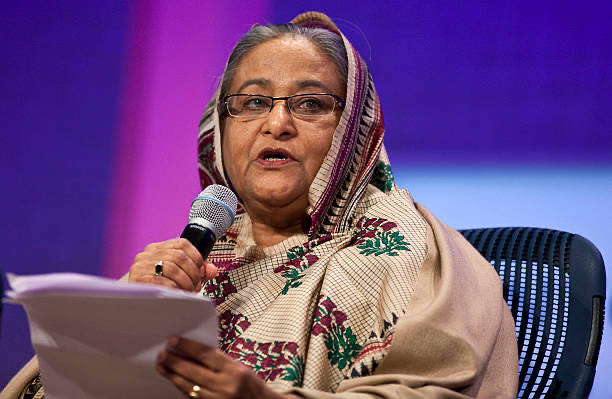
This is the first and exclusive interview post-International Crimes Tribunal (ICT) ruling where former Bangladesh Prime Minister Sheikh Hasina speaks to Manish Kumar Jha on a range of issues. The questions which were never asked before and never clarified, here is Sheikh Hasina, trying the explain the historic good and bad.
Since being forced from power and from her secret refuge in New Delhi, she raises her concerns about the fairness of the trial and the circumstances that led to the verdict. She also vehemently cuts through any extradition request that she says “should be dealt with through proper legal procedures and not used as a tool of diplomatic or political pressure.” Bangladesh achieved an average GDP growth of 6.29% annually over the past 15 years, which Seikh Hasina is very proud of.
Seikh Hasina also opens up on “external elements” — she says, “certainly there is some concerning evidence that foreign mercenaries may have been active in Dhaka during the worst days of the violence.”
Is Bangladesh getting radicalised at a fast pace, which is what I asked her about under the Yunus government?
At the same time, when I raised concerns about corruption and misuse of government finance of an estimated $234 billion, she denied the scale of corruption, said: Corruption sadly exists in all countries, but nobody has been able to show that my family and associates directly benefited from state resources or were complicit in state-sanctioned corruption.
But what about the reports which say many thousands die during the protest? Do you look for some sort of moral acceptance and apologies, formally here?
Here is the full interview:
What do you think about your trial and the verdict?
Sheikh Hasina: I respect the rule of law, which is why I categorically deny all charges brought against me. I remain deeply concerned about the fairness of the trial and the circumstances that produced the verdict. These charges have been brought by a kangaroo court that is controlled by my political opponents, who fabricated this prosecution in a transparent attempt to delegitimize the Awami League. Remember, not a single Bangladeshi has ever had the chance to vote for this interim government. It has no genuine respect for accountability or due process.
Why did you choose to go to India instead of another country? How did you approach Prime Minister Modi and the Indian government? How did they respond at that time?
Sheikh Hasina: India is and has always been Bangladesh’s most important ally and must remain so if Bangladesh’s security and prosperity are to be maintained. I am deeply grateful to the Indian people for providing me with a safe haven this past year. My contacts with the Indian government were handled through established diplomatic and legal channels.
Do you plan to return to Bangladesh in the future? Are you planning to stay in India for the rest of your life?
Sheikh Hasina: I want nothing more than to return to my home. However, I can only do so when there are clear security guarantees from a democratically elected authority. This depends entirely on whether Yunus holds free and fair elections. As of today, the largest party in Bangladesh, the Awami League, is being excluded from next year’s elections. Until that changes, there is little hope of having a truly representative government in Bangladesh.
Yunus’s interim government officially sent a letter to the Indian government about your extradition. What do you think about it?
Sheikh Hasina: Any extradition request should be dealt with through proper legal procedures and not used as a tool of diplomatic or political pressure. This request stems from a patently unjust legal process and has been made by an administration that is not governing with the consent of the people. Furthermore, it has been made by an administration which, ridiculously, has displayed open hostility towards New Delhi.
Bangladesh achieved an average GDP growth of 6.29% annually over the past 15 years, under your government. Widely noted, per capita income rose from $698 in 2009 to $2500 in 2023, even surpassing India in the region. Despite this, why was there such a mass uprising against you? Reports also point out the election rigging, political corruption over the years for such protests, alongside the “external hand” to destabilise Bangladesh, as you have already indicated. Can you clarify here, for all?
Sheikh Hasina: I am extremely proud of the economic progress achieved during my time in office. Growth and rising incomes reflect sound and strategic economic planning but, above all, the talent and hard work of the Bangladeshi people. Given rising prosperity, you’re right to suppose that economics had little to do with the events of July and August 2024.
As far as an “external hand” is concerned, we have all heard rumours, and certainly, there is some concerning evidence that foreign mercenaries may have been active in Dhaka during the worst days of the violence. But in the absence of an impartial and thorough investigation, it is difficult to draw conclusions. Until and unless a clearer picture emerges, my feeling is that the proximate cause of the uprising was firebrand activists from the opposition parties sowing division and hysteria, and working up resentment to the boiling point.
However, a recent report talks about corruption and misuse of government finance of an estimated $234 billion during the 15-year during your government. What is the basis of such an allegation, and do you deny that?
Sheikh Hasina: These allegations are completely unevidenced and plucked from thin air by my political opponents. Corruption sadly exists in all countries, but nobody has been able to show that my family and associates directly benefited from state resources or were complicit in state-sanctioned corruption.
The $234 billion claim is ludicrous. It far exceeds Bangladesh’s entire state budget. In practical terms, such an enormous theft isn’t even possible. If it had happened, our economy would have collapsed. But what actually happened was that our economy grew by 450% during my 15 years in office. That, by the way, is a figure verified by the IMF. It is also a concrete achievement that my accusers cannot hope to emulate. They prefer wild allegations over facts. They would be better advised to channel their efforts into improving the lives of ordinary Bangladeshis.
One of the key elements of Bangladesh’s rise is the suppression of radical elements for the stability and economic prosperity. Do you think Bangladesh is getting radicalised, and no measures are taken to curb this? Will Bangladesh’s approach towards Pakistan entice more radical elements in the systems? How did you look at such things while you were leading the government?
Sheikh Hasina: Stability and security have been essential to Bangladesh’s development. The secular nature of our politics is enshrined in Bangladesh’s constitution, and I was always keen to uphold that. While the state must take firm action against violent extremism, it should do so within the law and without infringing legitimate political freedoms.
Today, sectarian violence is rife, and ordinary Bangladeshis live in fear. We have already seen the rise of extremist factions linked to known terrorist organisations in everyday life. Many of these groups are spreading a hardline ideology and seek to oppress some of the most vulnerable in our society, including religious minorities, women, and girls.
I do fear our country is sliding toward radicalisation, so we must remain vigilant to guard against it. When I led the government, we sought to balance security with respect for rights. That balance must be preserved, or you will see cases of radicalisation flourish.
Reports say many thousands die during the protest. Do you look for some sort of moral acceptance and apologies, formally here?
Sheikh Hasina: I mourn each and every life lost in the tragic violence of last summer’s uprising. The implication that I ordered or directed the actions of the security forces on the ground is fundamentally incorrect. If people were harmed because of actions taken in the name of the state, those incidents should be investigated and, if wrongdoing is found, those responsible should be held to account.
Were you aware of the existence of the so-called “House of Mirrors” secret military detention centre? There are allegations that you were involved in this centre and the “enforced disappearance” of many dissidents under your rule. What is your response to these allegations?
Sheikh Hasina: Allegations like this are extremely serious. I categorically deny involvement in any programme of illegal detention or disappearance. These claims deserve independent, credible investigation; survivors and families deserve the truth. I support an impartial process that uncovers facts and ensures justice for victims.
Sheikh Hasina on ICT statement:
I must question, in the strongest possible terms, the very legality of the so-called International Crimes Tribunal in its current form. The ICT was created for one purpose only: to try the war criminals of 1971. It was never intended to be transformed into a political weapon against elected leaders of our country.
Under our Constitution, no executive order can acquire the force of law unless it is ratified by Parliament. Yet the Yunus administration has unilaterally rewritten the Tribunal’s mandate, extended its jurisdiction, and altered its procedures without any parliamentary approval. These actions are constitutionally void. They render every step the ICT has taken inherently unlawful.
And I ask this: what will happen if the next elected Parliament refuses to ratify these unlawful amendments? What becomes of the sentences handed down by this extraconstitutional body, especially if a life has already been taken? How can the state justify an execution carried out under a framework that never had any lawful standing? These are not merely legal hypotheticals. They expose the profound danger of allowing an unelected regime to manipulate judicial institutions for political ends, beyond the boundaries of our Constitution and the rule of law itself.

Leave a reply


SIDST- Strategic Insight for Defence Space and Technology- tHINK DEFENCE