
The Late Mover’s Advantage: India and the Quantum Disruption
By Manpreet Singh
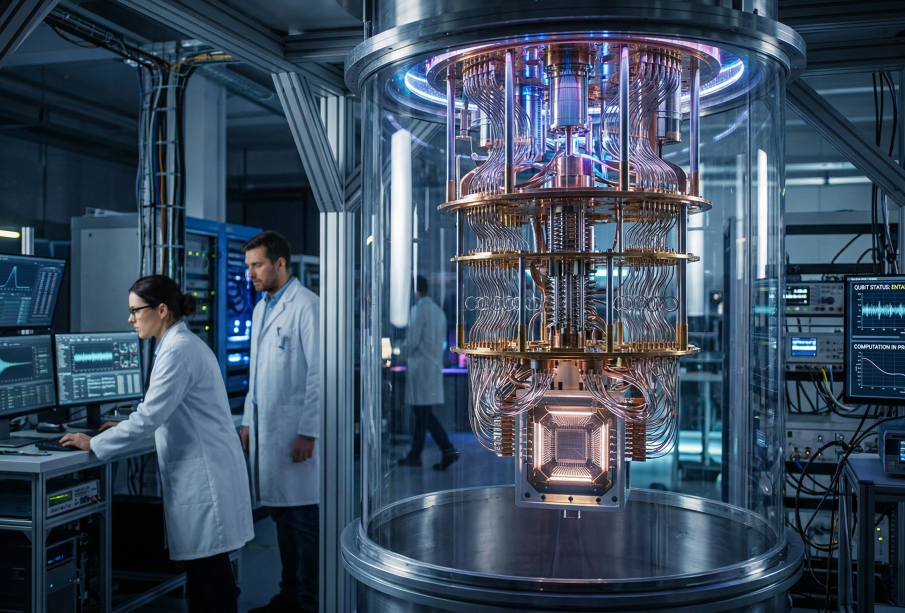
India has missed a few deep-tech waves due to a lack of organization, timing, and risk appetite rather than a lack of skill. A unique second chance is provided by quantum computing. The quantum race is still in flux, in contrast to traditional computing, when incumbents established decades-long advantages. India’s ability to leapfrog rather than catch up is the question.
Although uneven, quantum readiness is growing on a global scale. China leads in state-backed size and strategic deployment, particularly in quantum communication and cryptography; the United States leads in private-sector innovation and ecosystem depth; and Europe leads in foundational research and regulation. While fault-tolerant quantum computers are still years away, countries are working hard to develop quantum-safe security, hardware, and algorithms. Since no nation has yet established clear dominance in this environment, latecomers like India have a small but genuine window of opportunity to play a unique game.
India’s edge comes from leveraging its advantages in software talent and optimization-heavy businesses rather than directly competing in capital-intensive quantum hardware. The short-term benefits of quantum computing will manifest in hybrid models, in which early or quantum-inspired algorithms are added to classical systems. This is a wonderful fit for India’s scale difficulties, which include complicated supply chains, power grids, logistical networks, and financial risk systems. India can avoid a generation by emphasizing applied quantum advantage over pure hardware supremacy.
This turning moment has already been acknowledged by the government. Launched with substantial financing, the National Quantum Mission (NQM) seeks to develop capabilities in quantum materials, sensing, communication, and computation. Partnerships with startups and international actors are encouraged, and institutions such as IISc, IITs, and TIFR are positioned as research anchors. Additionally, early-stage quantum labs are emerging in defense research organizations and academia, and efforts are being made in quantum key distribution (QKD) for secure communication. The next stage must actively convert this into mission-driven applications, as the current strategy still largely favors infrastructure development and research grants.
India can—and ought to—move most quickly in the defense sector. The strategic significance of quantum technology is asymmetric, as minor advancements can result in significant benefits. Ultra-secure military networks that are impervious to interception may be made possible by quantum communication. Submarine detection, GPS-denied navigation, and surveillance accuracy can all be enhanced via quantum sensing. Even in its early stages, quantum computing has the potential to improve real-time decision-making under uncertainty, optimize battlefield logistics, and strengthen cryptanalysis. These are strategic needs, not futuristic luxury, for a nation managing intricate boundaries and multi-domain threats.
India must reconsider execution along three dimensions in order to leapfrog. First, switch from “research-first” to “use-case-first.” Ministries of defense, energy, and logistics should identify national issues and provide funding for quantum solutions with quantifiable results. Adopt hybrid ecosystems, second. India doesn’t have to manufacture every qubit at home; instead, it should combine domestic platform engineering and algorithm development with worldwide hardware access. Third, establish a framework for experimentation and procurement that enables research laboratories and startups to test concepts in practical settings, particularly in vital infrastructure and military.
By serving as both a first consumer and a funder, the government can act as a catalyst. Quantum pilots can be incorporated into defense procurement strategies. Quantum optimization can be tested in public sector businesses in the telecom, railroad, and energy sectors. Regulatory sandboxes can hasten the implementation of quantum-safe encryption in communications and banking. Additionally, talent programs need to change by integrating domain expertise, computer science, and physics into multidisciplinary training pipelines.
India’s true chance is to reinvent the quantum race rather than to win it as it presently exists. India may establish a distinctively strong position in the quantum era by emphasizing applications over abstractions, integration over creation, and scale over perfection. The payoff is generational, but the timeframe is small.
About the author: Manpreet Singh is a leading quantum experts based in the U.S. He writes and comments on next-gen advancement and its applications in quantum domain.
Disclaimer: The views, information, or opinions expressed during this series are solely those of the individuals involved–authors.

Leave a reply


SIDST- Strategic Insight for Defence Space and Technology- tHINK DEFENCE