
Palestine’s two-state solution model is ambiguous, partial self-governance, a federation of emirates only possibility, says Israeli Ambassador Reuven Azar
If we look at the context of 2025, what is the overall nature of our economic relationship?
The historical partnership between the two countries has existed for quite a long time.
I would like you to give your opening remarks on this.

Israeli Ambassador Reuven Azar speaks with Manish Kumar Jha, Editor: Defence Foreign Affairs, on conflict, terrorism, peace, and solutions.
Ambassador: The relationship between India and Israel has been truly excellent, because this partnership is based on trust and confidence, which we have continuously strengthened over the last 30 years.
Primarily, this relationship has focused on two areas—
first, defence, and second, water and agricultural cooperation.
However, this year, due to rapid progress in relations, we are also adding some new areas, such as infrastructure, finance, and research and development.
This is a very special relationship for both countries.
If I speak from Israel’s perspective, Israel views India’s economic progress very positively.
Israel considers India a reliable partner, especially for securing supply chains.
This trust has become very evident over the past year.
Last year, seven Israeli ministers visited India.
We signed several important agreements, including a Mutual Investment Agreement, and discussions on a Free Trade Agreement are also underway.
Overall, this year has been extremely positive for India–Israel relations,
and we are confidently looking forward to deepening this partnership even further.
Manish K Jha: Ambassador, I would like to highlight one important point.
Whenever India–Israel relations are discussed, the focus is often primarily on security and defence cooperation. But alongside this, as you mentioned, there is also a very strong and steadily growing economic partnership beneath the surface.
When I visited Israel, I saw a highly evolved startup and innovation system.
These are the very areas that India is also working on rapidly and learning from.
Today, India is also home to some of the largest numbers of unicorn startups in the world.
So, I would like to ask you—How does Israel’s innovation and R&D sector contribute to the Indian economy?
Ambassador: As you know, Israel has a very strong innovation ecosystem.
In fact, outside the United States, Israel is considered the largest innovation hub in the world.
We are encouraging our startups to collaborate with India.
First of all, in the defence sector, where our major companies, under the Make in India policy, are not just supplying systems but are jointly manufacturing advanced technologies in India itself.
Along with this, we are now also collaborating in research and development.
In the civilian sector, we have a joint fund called I4F,
which has so far invested around 25 million dollars in joint R&D projects.
This year, we launched another very important program called RISHI,
initiated between India’s DRDO and Israel’s Ministry of Defence,
to promote cooperation between dual-use and defence startups.
This program is progressing very well.
In Israel, the government provides strong institutional support.
We have an Innovation Authority that spends nearly half a billion dollars every year to support technology projects.
Importantly, the government even invests in projects where venture capital funds hesitate to take risks, because these projects often become future breakthrough technologies.
This ecosystem is based on government support and free enterprise together.
Companies are able to raise financing from the U.S. even at early stages.
This year, major deals took place in the cyber sector.
Two companies valued at over 30 billion dollars were acquired by U.S. companies.
Despite the war situation, we succeeded in attracting over 11 billion dollars in foreign investment into the startup sector.
So this is not just about the government’s role, but about the strength of our innovation ecosystem, which attracts foreign investment.
Manish K Jha: Your national effort is supported by strong government policies and funding.
We understand that Israel is among the countries where industry contributes the most to R&D.
My question is—what is the role of private industry in R&D? How does this entire ecosystem function?
Ambassador: We believe that the government can play a supportive role, but it cannot play a leadership role. Ultimately, that responsibility lies with researchers and innovators.
That is why, in every sector, we have created an ecosystem where all stakeholders sit together—
financial institutions, banks, venture capital funds, academic institutions, startups, and the government.
Together, they create a system of dialogue and collaboration.
This fosters an environment of innovation and provides startups with the necessary support and tools to grow.
Over the past 20 years, one major challenge for us has been the early exits of startups.
About 20–30 years ago, startups were being sold to foreign companies at very low valuations.
We realized that if we wanted to expand employment in the innovation sector,
we had to allow companies to grow bigger—either survive in the market or be sold at very high valuations.
By God’s grace, we have been largely successful in this direction.
Today, about 11 percent of Israel’s workforce is employed in the innovation sector.
Manish K Jha: We talk about the Israel–Palestine conflict now. Although a ceasefire is currently in place, incidents of violence are still occurring. Historically, we often hear about the two-state solution. What is your current position on this issue?
But first, on this extremely sensitive and important issue of the Israel–Palestine conflict,
we would like to hear your viewpoint.
Ambassador: Manish, what happened on October 7 was a brutal attack on Israel by the terrorist organization Hamas. They carried out massacres, rape, and arson against our civilians.
Following this, we were attacked on seven fronts, led by the Islamic Republic of Iran, which has sworn to destroy Israel.
So we are facing actors who do not want to resolve conflict. We are confronting malicious forces in the region, including Iran, Hezbollah, Hamas, Islamic Jihad, the Houthis, and others, who seek to eliminate our country.
We had to defend ourselves. Fortunately, after a prolonged conflict, we succeeded.
When Iran launched the largest missile attack in world history, we were able to neutralis it.
We also disabled their nuclear and ballistic missile programs.
In Lebanon, we inflicted heavy damage on the enemy and destroyed Hamas’s military machinery.
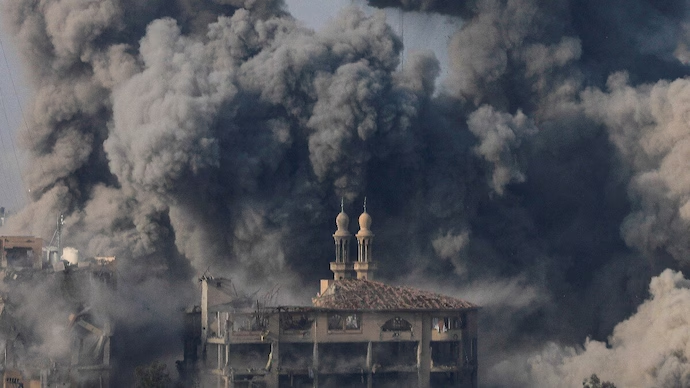
We now control approximately 58 percent of the Gaza Strip. We have also adopted the peace proposal prepared by President Trump.
Manish K Jha: Sorry to interrupt you, Ambassador, but I want to understand this area a bit more.
Israel’s intelligence agencies, security apparatus, and intelligence systems are considered among the best and most impenetrable in the world.
Yet this terrorist attack suggested that there was a breach in your security system.
Do you accept this? And if yes, how did this happen
Ambassador: Absolutely, it was a failure—both an intelligence failure and an operational failure.
We are focusing on this and investigating it to ensure it does not happen again.
But people must understand—Israel is the most attacked country in history.
Over the past 78 years, our military has faced conventional attacks. We have faced air, sea, and cyber attacks. We have also been attacked on international diplomatic platforms.
When attacks happen continuously, sometimes the enemy succeeds.
That is why we focus heavily on defence.We invest about 6 percent of our GDP in defence to ensure we can face every attack. But from time to time—perhaps once in 50 years or once in several decades— you receive a major shock.
You must learn how to absorb it, how to respond, and how to win.
Israel did exactly that— not only militarily, but economically as well. This has been one of the best economic years in our history.
This is directly linked to the commitment of Israeli citizens, not just security forces or intelligence agencies.
We have a civilian army, fully utilizing our human resources. Because they understand that we have no alternative— we have nowhere else to go.
This is Israel’s secret— the motivation of its citizens, their resilience and ability to endure attacks.
Manish K Jha: But Ambassador, from a historical perspective, what is the solution to this conflict? What do you think about the two-state solution? Please explain. Is there ambiguity around it, or do you consider it the right solution?
Ambassador: Yes, there is certainly ambiguity.
In the 1990s, when we were trying to make peace with our neighbours, we signed peace treaties with Egypt and Jordan.
At that time, there was a belief that perhaps creating a Palestinian state would bring peace.
Discussions were held in that direction.
But unfortunately, our proposals—which were quite generous— were rejected by the other side.
Especially since Hamas took control of Gaza, Palestinian society has experienced something like a civil war.
Palestinian society is not unified; it is divided.
In such a situation, when peace proposals are rejected and repeated attempts are made to destroy you, the level of risk you can take becomes very limited.
Therefore, the solution model must change.
We do not want to directly govern the Palestinian people, and we believe they deserve self-governance. But the limits of that self-governance must be determined through negotiations,
because we do not want to put ourselves in danger again.
Several ideas are being discussed in this context— for example, a federation of Palestinian emirates.
Because Gaza is unlikely to return to the control of the Palestinian Authority.
So, the question is how to create a framework where Palestinians receive self-governance on one hand, while Israel maintains a stronger role in security and sovereignty matters on the other.
Manish K Jha: This is somewhat different from the traditional two-state solution, which talks about full sovereignty and complete autonomy.
Ambassador: It may be partial self-governance, but for now, as long as extremism exists in Palestinian society and terrorist organizations remain active, this situation must be maintained.
Manish K Jha: So, you are saying that currently, there is no environment free from terrorist attacks,
where Hamas is peaceful, and violence has ended. Only when such an environment exists
can further discussions move forward?
Ambassador: Yes, then we may be able to begin negotiations for a peace agreement.
Manish K Jha: But Ambassador, when terrorist attacks occur, we in India also feel their impact. India does have hostile neighbours. We understand this situation and condemn these attacks,
because they are inhuman. But on the other hand, we also see that a humanitarian crisis is worsening in Palestine. It is often said that this is due to continuous blockades imposed by Israel for security reasons.
So, let me ask you— how does Israel manage this complex situation?
On one hand, you must stop terrorist attacks, and on the other hand, there are civilians—
children who need food and healthcare. You are a democratic country. How do you manage such a difficult situation?
Ambassador: We have made significant efforts to ease the humanitarian situation.
But we are also facing a propaganda campaign, because Hamas was using the humanitarian crisis
as a military and political weapon.
They attacked us while hiding behind civilians and prevented aid from reaching their own people.
For example, in recent weeks, we learned that during the worst phase of the Gaza crisis, Hamas had stockpiled children’s formula and did not distribute it.
Israel, unlike any other country, successfully delivered over 2 million tons of food and medical supplies to the Gaza Strip during the conflict.
This is not something most countries do during wartime.
Despite this, a large propaganda campaign was launched, including by Qatari Al Jazeera.
Manish K Jha: So, you deny that any blockade or obstruction was imposed during the humanitarian crisis?
Ambassador: We did not block humanitarian aid. Israel actually facilitated aid delivery.
When we realized Hamas was stopping the aid, we created alternative channels to deliver assistance, and we succeeded.
Ultimately, this is a very complex humanitarian issue. There is suffering on both sides.
Israeli civilians are suffering, and civilians in Gaza are suffering as well, because Hamas started this war and exploited the humanitarian situation.
You are right that Islamic extremism and jihadism are global problems. Dealing with them is our shared responsibility.
But the diplomatic community has not taken sufficient steps, and we ourselves have been victims of terrorism.
Some people try to explain terrorism by saying people are poor or frustrated. But terrorism can never be explained solely by poverty or frustration.
Manish K Jha: Absolutely not! Terrorism cannot be defined by poverty or despair.
Ambassador: There is inter-regional cooperation among these terrorist organizations.
They are also inspired by groups like ISIS, Hamas, and Palestinian Islamic Jihad.
There is also a copycat phenomenon, where others imitate these attacks.
If we want to prevent attacks like October 7 from happening again, there is much we can do together.
Manish K Jha: Ambassador, the topic you are raising is very interesting. The new form of terrorism
has evolved over the past decades. It has merged into civilian populations, making the work of governments, security agencies, and ordinary people extremely difficult.
So how do you deal with this situation, and how do you reduce its impact?
What does your counter-terrorism experience teach us? What is your counter-terrorism strategy?
Ambassador: Two things are crucial in dealing with terrorism.
First, creative thinking. Terrorists do not attack using old methods. They use new technology and social media. So we must adopt new and different approaches as well.
For example, in one attack, the communication technology provided to terrorists was turned against them.
Second, protection of civilians. Terrorists often hide behind civilians. Israel has developed technologies that warn civilians before attacks— sending messages, making phone calls, or giving small signals so people can evacuate buildings.
This saves civilian lives. Without these technologies, casualties would have been far higher.
Israel is now also teaching these methods to others. In recent months, military delegations from several countries visited to learn how to protect civilians while fighting terrorism.
Manish K Jha: So this means it is a combination of new technology and creative thinking
that is being used to confront this crisis— a crisis present in many countries today.
Now I would like to return to another very important topic—
India–Israel defence cooperation, along with the growing space partnership.
This cooperation is historic and multi-dimensional.
Recently, India’s Defence Secretary Rajesh Kumar Singh and Israel’s Director General of the Ministry of Defence, Major General Ami Baram, signed several agreements between the two countries. what developments are taking place in industrial and military cooperation?
We understand that Israel has provided India with several important defence systems—
such as Hero UAVs, missiles, Barak missiles, and support in many ways.
But we want to understand how Israel is contributing to India’s self-reliance in defence?
How is India adopting and developing advanced technologies like radars, missiles, and air-defence systems with Israel?
Ambassador: Manish, we have made significant improvements in the way defence cooperation works.
It began with solutions supplied by Israel, but gradually moved toward greater joint production in India.
Israeli companies such as IAI, Rafael, and Elbit are establishing companies in India.
These companies mainly maintain the systems we supplied—whether radar, aviation, or ammunition.
They are also working jointly with the government and private companies.
This cooperation is developing very well. That is why we signed Memorandums of Understanding
to expand government-to-government (G2G) cooperation.
We have also discussed updated security agreements that will allow technology expansion
and include private-sector collaboration.
Manish K Jha: Ambassador, let’s also talk about some technologies and equipment being developed in India. It is important to understand how these systems will help India become self-reliant in defence tech.
Ambassador: We have a policy— I cannot share specific technical details,
but I can say that our shared policy is building self-reliance.
We have seen, especially over the past two years— after October 7 and during the conflict— that when hostilities begin, you do not want to depend on another country.
You need to develop your own systems and ammunition, especially at the initial stage, to deal with a security crisis.
Manish K Jha: One final area I would like to ask about—semiconductors, robotics, and quantum technology.
These are big terms, but what is actually happening? What kind of cooperation is underway in these areas?
Ambassador: First, this year, we hosted a quantum delegation from India’s DST. We discussed ways to cooperate in quantum technology.
There has not yet been direct investment in quantum, but Indian private companies have invested in Israel.
This year, a major deal took place— the Indian electronics group Amber acquired the Israeli company Unitronics for 50 million dollars.
This benefits India in two ways: first, advanced products in the electronics sector; second, access to Western markets.
India is no longer focused only on the domestic market. As it emerges as a global power, its companies want to compete internationally.
To compete globally, advanced technology is essential. Here, Israeli and Indian innovation can complement each other— Israel brings new technology, and India knows how to scale it.
We are looking for partnerships that help upgrade and scale technology.
Manish K Jha:
But the final and very important topic— the India–Middle East Economic Corridor, which has been widely discussed.
Do you think this is actually viable, especially amid the ongoing conflict?
What is the roadmap— not just announcements, but the actual plan?
Ambassador:I am completely confident that this plan will succeed.
Let me explain why.
First, economic interest. India, the Gulf countries, and Israel all have economic stakes in it.
When economic interests align, solutions eventually emerge.
Second, the opening of new areas of cooperation, such as infrastructure.
Israel plans to invest 200 billion dollars in infrastructure over the next 10 years, and Indian companies are being encouraged to participate.
When routes are built not only for trade but also for infrastructure and energy projects, this corridor will take shape.
The greatest strength of this corridor is that it will connect stable, development-oriented countries.
With stable governments and stable environments, companies can ensure their goods reach destinations on time.
That is why I am fully confident we will find a way to make it successful.
Manish K Jha: I thank the Ambassador.
Thank you for discussing the wide range of issues in India–Israel bilateral relations with us.
Plz note: The interview took place on Zee Network originally by Manish Kumar Jha with the Israeli Ambassador.



Leave a reply


SIDST- Strategic Insight for Defence Space and Technology- tHINK DEFENCE