
Expect to Sign Some Contracts in 2026; DRDO Reforms Top Government Agenda, Defence Secretary
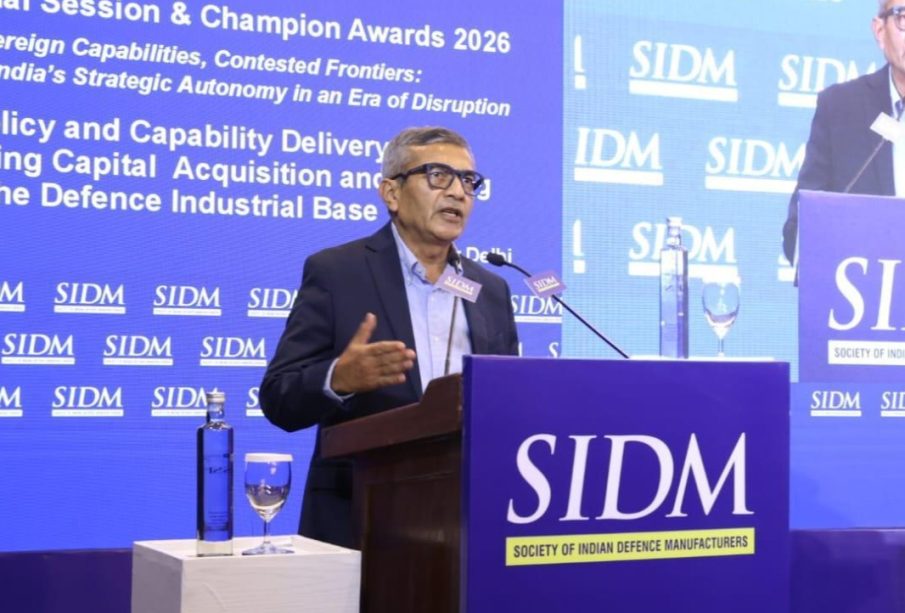
Several major defence acquisition programmes, including the Multi-Role Fighter Aircraft (MRFA) project, are under consideration at the highest levels, with the government aiming to move some procurement proposals towards contract signing before the end of 2026, Defence Secretary Rajesh Kumar Singh has said.
The Defence Secretary talked about such development while responding to the question raised by Manish Kumar Jha, founder, Strategic Insights at the SIDM annual conference in New Delhi on October 9.
While acknowledging the pace of reforms and, further, the intent to reform initiated under the Defence Secretary, there are still some big-ticket platforms pending.
From a national security perspective, some broad platforms, some highly complex and advanced platforms, are being delayed; for example, say, jet engines. Another crucial project like P-75 (I) is hanging.
Defence Secretary ponited out that the Ministry of Defence is also working to secure final approval for proposed changes to the Defence Acquisition Procedure (DAP) by the end of the year. The reforms are intended to simplify procurement, reduce delays in field trials and evaluations, and speed up cost negotiations and contract finalisation.
While acknowledging an improvement in the number of defence contracts signed, Singh said the pace of procurement needed to accelerate further.
Expediting major acquisitions, advancing fighter aircraft procurement and progressing jet engine co-production arrangements remain key priorities. He stressed, however, that procurement procedures must be followed to ensure transparency, accountability and legal scrutiny.
DRDO restructuring and research priorities
Alongside procurement reforms, the government is pursuing a restructuring of the Defence Research and Development Organisation (DRDO), with a sharper focus on scientific research and advanced technology development.
Singh said the proposed changes would establish clearer roles and responsibilities within the organisation, allowing DRDO to concentrate on research rather than routinely undertaking systems integration or manufacturing in conventional areas. Production-related activities could continue in specialised strategic sectors where viable alternatives are not available.
The broader objective is to enable domestic industry to manufacture and commercialise technologies developed through publicly funded research, while allowing DRDO laboratories to focus on next-generation capabilities.
The government is also examining the rationalisation of DRDO’s laboratory network to reduce duplication and improve research efficiency. Recommendations associated with the VijayRaghavan Committee have called for consolidating the existing network of around 50 laboratories into approximately 33–35 core research centres.
The proposed restructuring also seeks to reduce overlapping research programmes, strengthen accountability for project timelines and simplify administrative procedures. Measures to ease the paperwork burden on scientists, including procurement-related responsibilities involving the Government e-Marketplace (GeM), are also under consideration.
Singh said talent and accountability would be central to the transformation, while acknowledging DRDO’s contribution to India’s strategic programmes and scientific capabilities.
Industry at the centre of defence manufacturing
The government is looking to expand the role of Indian industry as defence production and procurement gather pace. Singh estimates that India could see an annual defence budgetary outlay of around $20–25 billion over the next decade, with 75% of capital procurement earmarked for domestic sources.
The emphasis, he indicated, is on building stronger partnerships among defence public sector undertakings, private manufacturers, start-ups and micro, small and medium enterprises (MSMEs), rather than treating them as isolated suppliers.
Private industry currently accounts for approximately 24% of India’s defence production. The government wants to increase its contribution and create a more balanced industrial ecosystem in which public and private companies work together to develop, manufacture and sustain advanced defence systems.
The procurement and DRDO reforms form part of a broader effort to accelerate military modernisation, strengthen indigenous research and development, and reduce dependence on foreign suppliers. The challenge will be to translate policy changes into faster deliveries, greater domestic technological capability and a more competitive defence manufacturing base.
Exceprts:
Manish Kumar Jha: Your reforms and intent to reform are very visible. But from a national security perspective, some broad platforms, some highly complex and advanced platforms, are being delayed; for example, say, jet engine project has not yet started. Another crucial project like P-75 (I) is hanging.
Could you please talk about the such programmes which are awaiting approval yet? Also, I also would like to ask: especially in aerospace, there are so many parallel programs- AMCA, Tejas 2, MRFA and a potential fifth-generation fighter programme. Where to focus, as there is only one (Aeronautical Development Agency (ADA) to work on that. I hope it will make a difference from leadership.
Defence Secretary: You ended up asking about procurement, although you stated it in different words. So, on the program, I will not say anything except that all of the programs that you mentioned are being processed at the highest levels, and I have mentioned one on one or two others which are also in the line, including MFA and a few others.
All of them are. I mean, in a democracy, you have to go through a certain process to get these things done. If you don’t do it through that process, you end up jeopardizing the entire procurement you know of program itself.
So, all of those items that you mentioned and a few that you did not mention all are being processed, and hopefully some of them will translate into contracts Finance within this calendar. Thank you.
Author





Leave a reply


SIDST- Strategic Insight for Defence Space and Technology- tHINK DEFENCE