BRICS and the Global South: Can the Expanded Bloc Build a More Balanced World Order
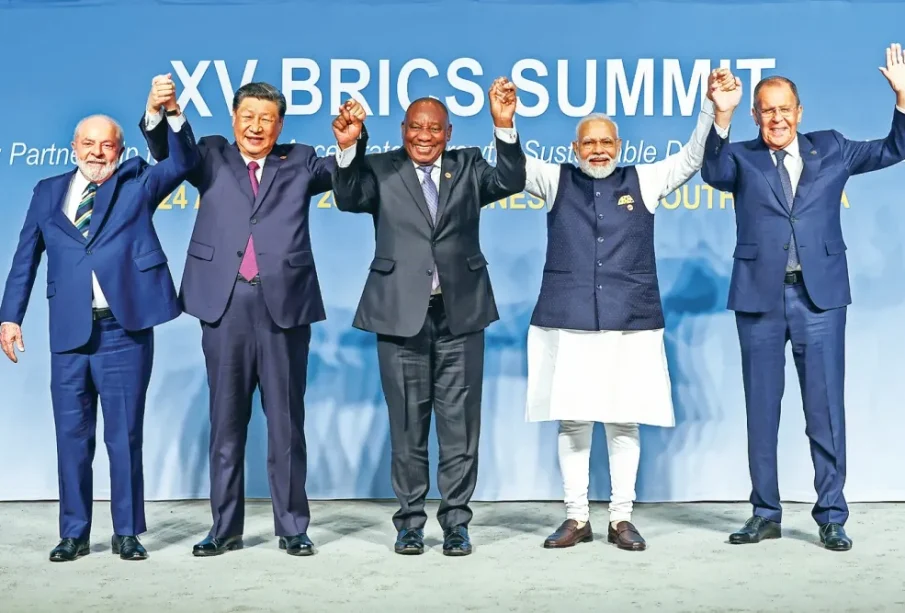
India will bring together leaders of major emerging economies and developing countries in New Delhi this week for the 18th BRICS Leaders’ Summit. This meeting carries particular significance as the grouping marks two decades of its evolution from a small emerging-market forum into a broader platform for the Global South.
India, which holds the BRICS Chairship in 2026, will host the summit at Bharat Mandapam in New Delhi on September 12–13. Leaders from BRICS member and partner countries, along with outreach invitees, are expected to participate in the two-day summit.
What began with Brazil, Russia, India and China eventually became BRICS with the entry of South Africa, and has now expanded to 11 members: Brazil, China, Egypt, Ethiopia, India, Indonesia, Iran, Russia, Saudi Arabia, South Africa and the United Arab Emirates. Indonesia’s entry as a full member further broadened the grouping’s geographical and economic reach.
Together, the expanded BRICS represents almost half of the world’s population and around 39% of global GDP, according to BRICS’ own institutional material. Its members also account for a substantial share of global energy production.
The question now is no longer whether BRICS has economic weight. It clearly does. The bigger question is whether that weight can be translated into greater strategic, financial and institutional influence for the Global South.
From an economic grouping to a Global South platform
BRICS was never designed as a conventional military or political alliance. Its original objective was to give major emerging economies greater collective influence in international economic governance.
The global economic system has changed dramatically since 2009 when BRICS was founded. But developing countries continue to face disadvantages in access to capital, technology, energy security and global decision-making.
BRICS can potentially provide a collective platform through which emerging economies negotiate these issues rather than addressing them individually.
This is perhaps the grouping’s greatest strength: collective bargaining power.
India, Brazil, South Africa, Indonesia and other members bring large populations, growing consumer markets, natural resources and technological capabilities. China remains a manufacturing and trading giant, while Russia, Saudi Arabia, the UAE and Iran bring enormous energy resources. Egypt and Ethiopia provide important links to Africa and the Middle East.
If these strengths are coordinated rather than fragmented, BRICS can become a powerful economic voice for countries that have traditionally had limited influence over the rules of the global economy.
The New Development Bank: A practical instrument
The most important evidence that BRICS can move beyond declarations is the New Development Bank (NDB).
Created by the original BRICS members, the NDB was designed to finance infrastructure and sustainable-development projects in BRICS countries and other emerging and developing economies. The bank has approved more than $42 billion in financing across 139 projects, according to its latest published figures.
This matters because infrastructure financing remains one of the biggest constraints facing developing economies.
India’s own experience illustrates the potential. The NDB has financed major Indian infrastructure projects, including metro and regional rapid-transit infrastructure. In 2026, discussions between India and the NDB also focused on expanding rupee financing and developing the bank’s local-currency operations.
This could become one of BRICS’ most consequential contributions to the Global South: reducing dependence on foreign-currency borrowing for development projects.
The payments question
Another major issue is the search for more efficient cross-border payment mechanisms.
There has been considerable discussion about a possible BRICS currency, but that should not be confused with the more realistic objective of greater interoperability among national payment systems and increased use of local currencies.
A full-fledged common BRICS currency would face enormous challenges. The member economies have different monetary policies, exchange-rate regimes, capital controls and political priorities. A common currency would require a degree of economic integration that does not currently exist.
For many developing countries, that could be more valuable than a symbolic alternative currency.
But China remains the central challenge
The expansion of BRICS is simultaneously its greatest opportunity and its greatest challenge.
China’s economic size gives it enormous influence within the grouping. Its manufacturing capacity, trade networks and financial resources are unmatched by other BRICS members.
That creates an unavoidable question: Can BRICS become a genuinely multipolar platform if one member is substantially more economically powerful than most of the others?
India, Brazil, South Africa, Indonesia and several other members are unlikely to accept BRICS becoming an instrument of any single country’s geopolitical agenda.
This is why the future of BRICS will depend on maintaining strategic autonomy and institutional balance.
The opportunity is historic. The challenge is to convert collective weight into collective influence.
Author


Leave a reply


SIDST- Strategic Insight for Defence Space and Technology- tHINK DEFENCE